Stop Practising for A Role.
Start Practising for THE Job.
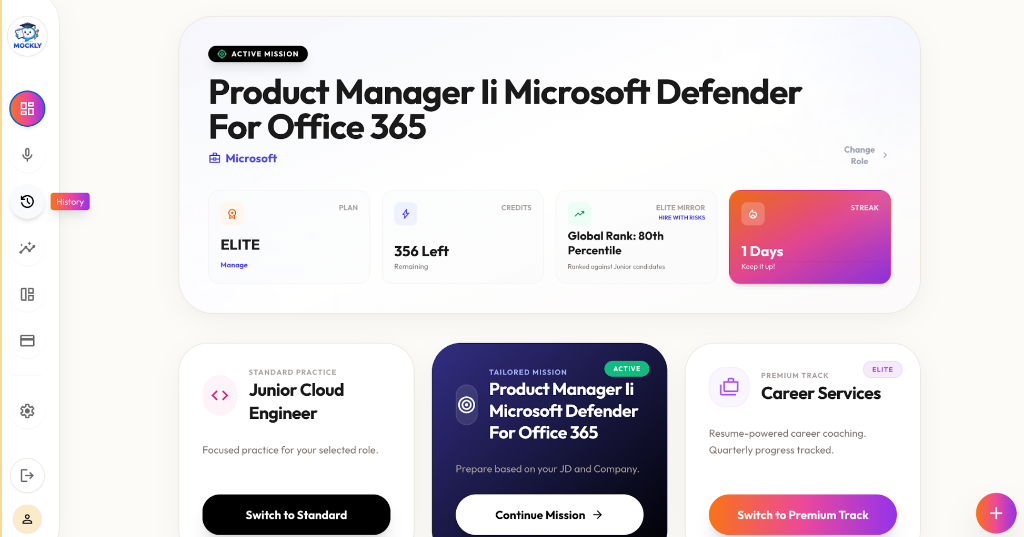
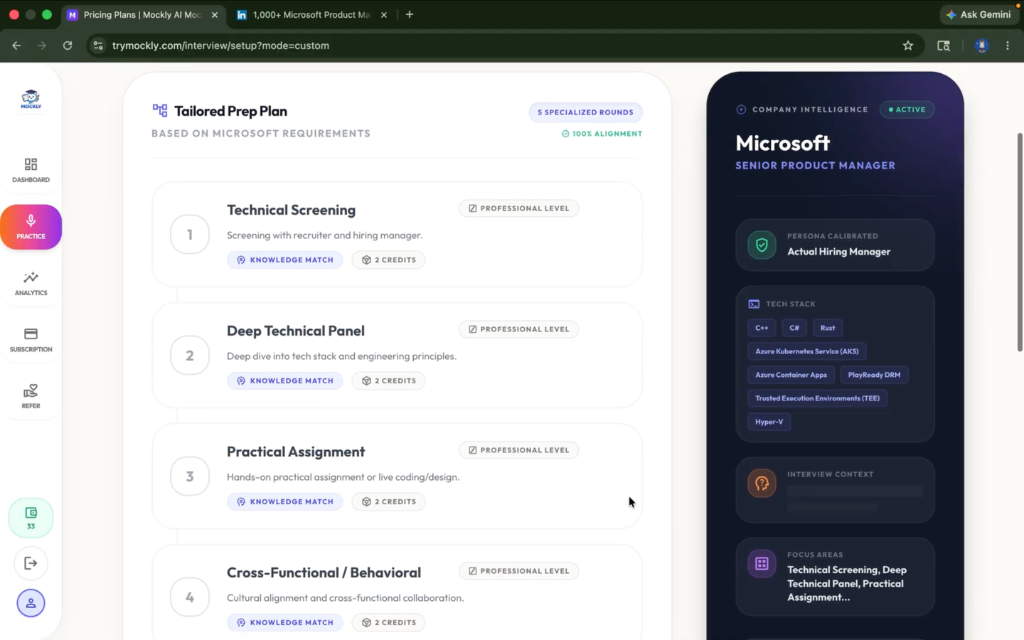
Paste your target Job Description. Mockly builds a custom 5-round PM interview plan calibrated to that exact company's bar-raiser expectations, tech stack, culture signals, and seniority level — not a generic PM template.
- 🎯Company Intelligence — Actual hiring manager persona calibrated per role
- 📋5 Specialized Rounds — Built for the exact PM competencies this company tests
- ✅100% JD Alignment — Questions mapped to your specific role requirements
Know Exactly Where
You Need to Improve.
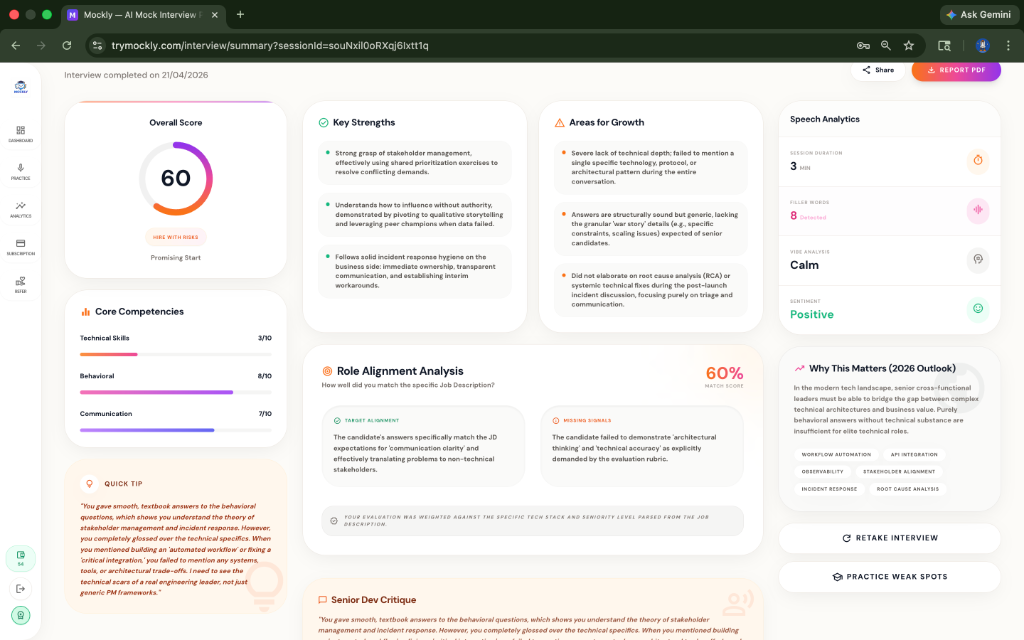
After every session, Mockly delivers a diagnostic breakdown — not generic tips. See your core competency scores, exactly what you said that fell short, and your role alignment score against the specific JD.
- 📊Overall Score + Core Competency breakdown (Technical, Behavioral, Communication)
- 🔍Key Strengths and Areas for Growth — specific to what you actually said
- 🎤Speech Analytics — filler words, tone analysis, sentiment, session duration
Who Is This For?
PM interviews test different things depending on where you are in your career. Mockly adjusts to your situation.
PMs targeting a new role
You have the experience. The challenge is translating it into structured, compelling answers under pressure — without the preparation that most candidates skip.
Career switchers moving into PM
You're mapping transferable skills onto PM frameworks. You need reps to internalize product thinking before your actual interview, not during it.
PMs preparing for promotion interviews
Internal promotion interviews are often harder than external ones. Stakeholders know your existing gaps. The bar is higher because the context is richer.
Senior PMs targeting director roles
Director interviews shift from execution to leadership thinking. The questions are more ambiguous, the strategy depth is higher, and the behavioral bar is more demanding.
What Does a Product Manager Interview Actually Test?
Most candidates prepare for questions. Strong candidates prepare for competencies. Here is exactly what PM interviews are designed to evaluate.
Product Sense
User empathy, design thinking, and the instinct to build the right thing.
Product Strategy
Business acumen, market reasoning, and competitive positioning.
Analytical Thinking
Data-driven decision-making and metrics fluency.
Execution
Shipping discipline, stakeholder coordination, and tradeoff management.
Prioritization
Making hard calls with incomplete information under resource constraints.
Stakeholder Management
Aligning people who disagree — engineering, design, sales, leadership.
Leadership & Influence
Moving an organization without direct authority over every decision.
Communication
Precision and clarity under pressure, especially in follow-up moments.
Your Product Manager Interview Journey
A full PM interview process typically runs five rounds. Each round tests different competencies — and requires completely different preparation.
Round 1: Recruiter Screen (20–30 min)
Background, motivation, compensation expectations, logistics, and basic qualification check.
What They Evaluate
- Communication clarity and professionalism
- Genuine, specific interest in the company and role
- Logical career narrative and trajectory
- Compensation and logistics alignment
Common Questions
- "Walk me through your background."
- "Why are you interested in this role?"
- "Why are you leaving your current company?"
- "What are your compensation expectations?"
Common Mistakes
- Rambling through your entire career — target 90 seconds
- Generic "why this company" answer — name specific products or initiatives
- Discussing compensation before the recruiter raises it
Round 2: Product Sense (45–60 min)
Product design, product improvement, user empathy, feature ideation, and prioritization.
What They Evaluate
- User-centric thinking: Do you start with the user or the technology?
- Structured problem decomposition
- Creativity within constraints
- Prioritization rationale: Can you justify what you would build first?
Common Questions
- "How would you improve Spotify's mobile app?"
- "Design a product to help remote workers stay focused."
- "What's your favorite product and what would you change about it?"
- "How would you redesign the airport check-in experience?"
Common Mistakes
- Jumping directly to features without understanding the user
- Proposing technically complex ideas without acknowledging tradeoffs
- Skipping prioritization — "we should build all of these" is a red flag
- No success metrics for your product decisions
Round 3: Product Strategy & Execution (45–60 min)
Market entry, product vision, roadmap prioritization, go-to-market decisions, and metrics definition.
What They Evaluate
- Business acumen: Can you connect product decisions to revenue or competitive position?
- Strategic thinking: Can you reason about market dynamics and moats?
- Metrics fluency: Can you define success with leading and lagging indicators?
- Tradeoff reasoning under real constraints
Common Questions
- "How would Spotify enter the podcast advertising market?"
- "What metrics would you track for a new feature launch?"
- "How would you prioritize your Q4 roadmap given limited bandwidth?"
- "Should Slack build a video calling feature?"
Common Mistakes
- Confusing strategy with tactics
- Ignoring competitive dynamics
- Proposing KPIs without a measurement plan
- Treating every roadmap decision as equally important
Round 4: Behavioral & Leadership (45–60 min)
Conflict resolution, influence without authority, handling ambiguity, failure and learning, cross-functional collaboration.
What They Evaluate
- Self-awareness: Do you know your strengths and blind spots?
- Professional maturity under difficult situations
- Influence without authority
- Growth orientation: Do you genuinely learn from setbacks?
Common Questions
- "Tell me about a time you influenced without direct authority."
- "Describe a product decision that turned out to be wrong."
- "How did you handle a disagreement with your engineering lead?"
- "Tell me about a time you killed a project you had championed."
Common Mistakes
- Sanitizing failure stories — interviewers want real accountability
- Claiming sole credit in team stories
- Weak self-reflection — describing what happened without what you'd do differently
- Vague answers without a specific, real situation
Round 5: Final / Hiring Manager (45–60 min)
Leadership philosophy, culture alignment, ambition, vision, and the decision-maker's personal assessment.
What They Evaluate
- Will this person succeed here? (skills + fit + trajectory)
- Do I want to work with and for this person?
- Does their vision align with where we're going?
- Can they grow beyond this role over the next 2–3 years?
Common Questions
- "Where do you want to be professionally in five years?"
- "What kind of problems genuinely excite you?"
- "Describe your management philosophy."
- "What do you want to learn from this role?"
Common Mistakes
- Generic future-goal answers — "I want to be a VP" is a position, not a vision
- Poor cultural research — not knowing the company's current priorities or recent launches
- Weak questions back to the interviewer
- Overconfidence or underconfidence
PM Interview Practice Questions
30+ Product Manager interview questions organized by competency. These are the actual question types you will encounter across all five rounds.
- How would you improve Spotify's mobile app?
- Design a product to help remote workers stay focused.
- What's your favorite product and what would you change about it?
- How would you redesign the airport check-in experience?
- Design a feature to help new YouTube users discover content.
- How would you improve LinkedIn's job recommendation algorithm?
- How would you enter the Indian food delivery market?
- Should Slack build an in-app video calling feature?
- How would you grow Duolingo's paid subscriber base by 30%?
- What's the biggest strategic threat to Airbnb's business?
- How would you decide whether to build, buy, or partner for a new capability?
- What's your North Star metric for a B2B SaaS product and why?
- Our DAU/MAU ratio dropped 15% last month. How do you diagnose this?
- What metrics would you track for a new user onboarding flow?
- If you could only track one metric for a marketplace, what would it be and why?
- How would you structure an A/B test for a pricing change?
- Conversion dropped 10% after a feature launch. Walk me through your investigation.
- You have 3 features to build and bandwidth for only 1. How do you decide?
- Engineering says your top priority will take 6 months. What do you do?
- How do you manage a roadmap when sales keeps adding urgent requests?
- Walk me through how you'd write a PRD for a new feature.
- How do you work with design when you have genuinely different opinions?
- Tell me about a time you shipped with significantly fewer resources than needed.
- Describe a product decision you made that turned out to be wrong.
- Tell me about a time you influenced a decision without direct authority.
- How did you handle stakeholders with directly conflicting requirements?
- Describe a time you had to kill a feature or project you had championed.
- How do you align a team around a strategy they initially disagreed with?
- Describe your approach to giving difficult feedback to a peer.
- How do you develop junior team members while still driving delivery?
- Tell me about a time you represented your team's work to senior leadership.
What Happens Inside Mockly
From your job description to a complete practice session in minutes.
Upload Your Job Description
Paste the exact PM role you're targeting. Mockly reads the company, seniority level, required competencies, and specific language used in the posting.
Role Analysis
Mockly maps the key competencies being tested for this specific role — product sense weight, strategy depth, technical expectations, and behavioral focus.
Personalized Interview Plan
A five-round interview plan is built specifically for your JD. Not generic PM prep — the interview that company actually runs for that role.
AI Interviewer Begins
A voice-based AI interviewer opens the session, calibrated to your seniority and role context.
Natural Voice Conversation
Answer verbally. The interviewer listens, processes your answer, and responds in real time — the same rhythm as a live interview.
Follow-up Questions
"Why did you choose that metric?" "What would you do if engineering pushes back?" Follow-ups are where real interview preparation happens.
Performance Feedback
After the session: analysis of answer quality, communication clarity, competency coverage, and specific areas to focus on before your real interview.
What You'll Actually Improve
Practicing correctly — out loud, under realistic pressure, with follow-up questions — develops specific skills that reading question lists cannot.
Answer Structure
STAR framework execution, hypothesis-first thinking, top-down communication — the structural discipline that separates good from great PM answers.
Product Thinking Fluency
Move from vague instincts to structured, user-centric problem decomposition. Know exactly where to start on any product design question.
Composure Under Follow-up
Practice the exact moment a curveball follow-up catches you off guard. Build the response pattern before it happens in a real interview.
Conciseness
Learn to say what matters in 90 seconds, not 4 minutes. Strong PM answers are dense and direct, not comprehensive and exhausting.
Business-First Framing
Every product decision connects back to a business outcome. Practice building that bridge until it becomes automatic.
Confident Verbal Delivery
Vocal pace, energy, and not hedging every answer — the delivery signals that experienced interviewers read immediately.
Why Candidates Practice PM Interviews on Mockly
Not generic claims. Specific, tangible product attributes that make the practice more realistic and more useful.
Your JD is the starting point
You're not practicing a generic Product Manager interview. You're practicing the interview for the exact role and company you're targeting — with questions calibrated to that role's actual requirements.
Voice-based simulation
PM interviews are spoken conversations. Clicking through a question card app doesn't train spoken communication. Mockly uses voice because that's how you'll actually be evaluated.
Full five-round simulation
A single behavioral question is not interview preparation. Mockly simulates the complete arc — recruiter screen through hiring manager — so you practice the full process, not isolated moments.
Follow-up conversations
The hardest part of PM interviews isn't the first question. It's the follow-up. Mockly asks "Why that metric?", "What if engineering disagrees?", and "Walk me through that decision." Because that's what real interviews do.
Immediate diagnostic feedback
After each session, see exactly where your answers fell short — answer depth, structure, business framing — and what to work on before your next real interview.
Start Practicing Today
No commitment required. Start with a free trial and decide from there.
Free Trial
Start a product manager mock interview right now. No credit card, no commitment. Get a feel for what JD-matched practice actually is.
Start Free Interview →Full Access Plans
Unlimited sessions across all five rounds, all role types, full feedback, and multi-round interview plans calibrated to any JD.
See All Plans →Frequently Asked Questions
Your PM Interview Is
Already Scheduled.
Practice it before the real one. Build your JD-matched interview plan, run all five rounds, get feedback, and walk in having already done it once.
Start Your Product Manager Mock Interview →Free to start · No credit card required